How Mobile Platforms Reshape Traditional Blackjack Decision Trees Across Global User Bases
Blake Keller · Aug 22, 2026

How Mobile Platforms Reshape Traditional Blackjack Decision Trees Across Global User Bases
Traditional blackjack decision trees map out every possible player hand against each dealer upcard, and mobile platforms now deliver those trees through touch interfaces that alter selection speed and accuracy across regions. Data from industry reports show that mobile sessions account for over 65 percent of online blackjack activity in multiple markets by mid-2026, which forces adjustments in how basic strategy charts translate to smaller screens and gesture-based inputs. Researchers at gaming analytics firms have tracked shifts in hit-versus-stand choices when players use one-handed operation on smartphones compared with desktop layouts that allow full keyboard shortcuts.
Interface Changes and Decision Tree Adaptations
Screen size constraints lead developers to collapse multi-step branches of the classic decision tree into single-tap menus or swipe gestures, and studies indicate that users on devices under six inches complete fewer double-down decisions per hour than those on tablets. Observers note that auto-hold features in several major apps pre-select actions based on simplified trees, which reduces deviation rates in low-stakes global user pools yet increases them when players override suggestions during high-variance streaks. In August 2026, platform updates from operators serving European and Asian markets introduced dynamic tree overlays that highlight only three optimal moves at once, cutting cognitive load while maintaining the mathematical edge calculations originally derived from large-scale simulations.
Regional regulations further modify these trees because certain jurisdictions restrict real-time strategy assistance, so mobile versions strip out hint systems that desktop clients still display. Figures from the New Jersey Division of Gaming Enforcement reveal that mobile blackjack handle grew 22 percent year-over-year through the first half of 2026, with decision patterns showing fewer splits on pairs of eights in markets where quick-tap interfaces dominate. Those same datasets indicate that users in Australia and Canada complete more insurance bets on mobile when the dealer shows an ace, partly because the prompt appears directly above the bet slider rather than in a separate panel.
Global User Base Variations in Strategy Execution
Player cohorts in East Asia exhibit faster adherence to basic strategy trees when apps incorporate local payment flows and language settings, whereas North American users demonstrate higher rates of deviation during live dealer sessions streamed to phones. A report issued by the American Gaming Association in early 2026 documented that mobile blackjack participation among users aged 25-34 reached 48 percent of total table game volume, coinciding with measurable drops in surrender frequency because the option often requires an extra confirmation tap. Experts tracking multi-country panels have found that decision consistency improves when apps allow offline tree downloads, which players in regions with intermittent connectivity access more frequently.
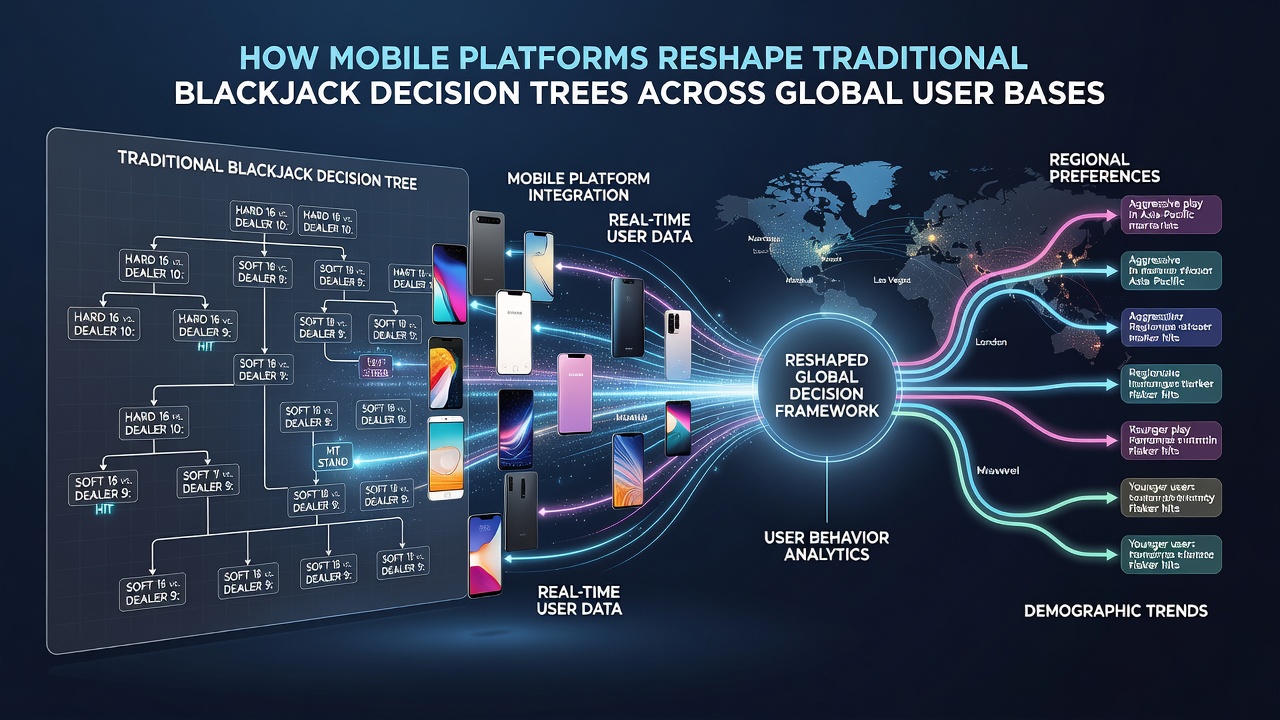
Cross-border data flows also influence tree presentation because operators serving multiple licenses must balance house-edge rules with platform-specific UX tests, and evidence from aggregated telemetry shows that European users favor conservative stand thresholds on mobile while Southeast Asian cohorts accept more aggressive hit calls under identical hand conditions. Academic papers examining portable device ergonomics note that thumb reach zones on vertical screens bias selections toward central buttons, which in blackjack apps correspond to stand and hit actions more often than split or double. Consequently, some platforms reposition those secondary actions to edge zones or add long-press alternatives to restore balance across the full decision tree.
Real-Time Analytics and Adaptive Trees
Analytics layers now feed session data back into personalized decision trees that adjust recommendations based on prior mobile behavior rather than static charts, and operators report that retention metrics rise when these adaptations respect jurisdictional limits on assistance. In markets monitored by the Malta Gaming Authority, mobile blackjack volumes crossed previous desktop benchmarks during 2025-2026, accompanied by lower average deviations from optimal play once adaptive prompts were introduced. Yet those same systems track how network latency during peak hours in South America alters timing-sensitive choices such as early surrender, prompting providers to cache simplified trees locally.
Device fragmentation adds another variable because foldable phones and high-refresh-rate screens change animation speeds for card reveals, which indirectly affects how quickly players process the next branch of the tree. Telemetry collected across platforms indicates that users on premium handsets execute multi-card draws with fewer pauses than those on entry-level devices, producing measurable differences in realized return-to-player figures when aggregated by region. Industry organizations such as the European Gaming and Betting Association have published summaries showing that mobile blackjack now represents the fastest-growing segment within regulated online table games, driven by these incremental interface refinements rather than wholesale rule changes.
Conclusion
Mobile platforms continue to translate traditional blackjack decision trees into formats shaped by hardware limits, regional rules, and usage patterns that differ across global audiences, with data through August 2026 confirming sustained growth in mobile handle alongside gradual convergence toward optimized gesture-based execution. Observers expect further refinement as 5G coverage expands and new device categories enter consumer hands, each carrying its own implications for how the core mathematical structure of blackjack strategy reaches players.